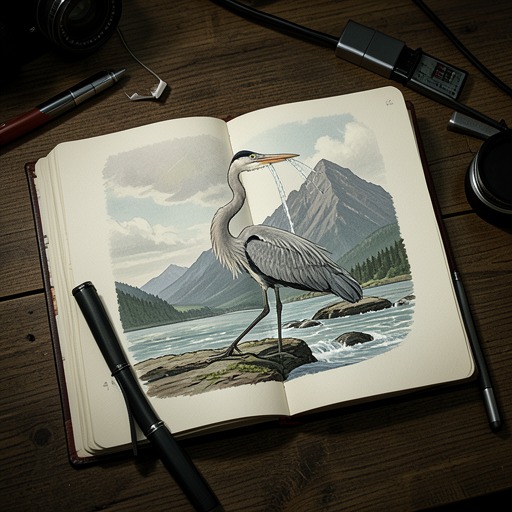
Fugu
Winter in SokchoFugu is a poisonous fish whose preparation gives the narrator’s mother a rare professional distinction and the narrator a difficult measure of skill. In the family’s kitchen, it is at once a delicacy offered to guests, a source of danger requiring exact technique, and an art the narrator has watched but has never been permitted to practise. When she finally prepares it herself, the fish becomes a test of whether careful attention can reproduce her mother’s mastery—and a dish she wishes she could show her.
A Dangerous Delicacy and a Professional Skill
The narrator’s mother is the only fishmonger in Sokcho licensed to prepare fugu. Its organs contain lethal toxins, but the translucent flesh can be made into what the narrator describes as works of art when handled by someone with the necessary skill. Her mother serves the fish when she wants to dazzle guests, so its appearance carries the force of a performance as well as the risk of a technical mistake.
That expertise is visible in the contrast between the finished dish and the work behind it. The mother removes the fish’s fins and skin in swift motions, then carefully extracts its poison-laden intestines, ovaries, and liver without piercing them. The narrator watches, but watching does not grant her permission to take part: her mother has never allowed her to handle fugu. The boundary makes the fish an emblem of knowledge possessed by one generation and withheld from the next, even while the daughter studies the movements closely.
Fugu also enters the family’s preparations for Seollal. A week before the meal, the mother needs it but finds only octopus available at the fish market. At the gathering, the aunt praises the fugu sashimi, which she says she does not eat in Seoul: she distrusts the chefs there who claim to be licensed, assumes they are Japanese, and fears that they might kill Koreans. Her suspicion turns the dish into a charged subject of national distrust as well as a display of culinary expertise. Yet the meal does not present skill as effortless perfection. The aunt notices the greyish color of the octopus dish, and the mother blames the narrator for piercing its ink sac, saying she cannot be trusted with a knife.
Watching the Work, Crossing the Boundary
The narrator’s own attempt begins before dawn, at the fish market. Moving through the unloading area with a torch, she sees octopuses squirming in tanks and hears her footsteps and the water amplified in the space. Her mother’s fugu float open-mouthed in their tank; their teeth have been pulled so they cannot harm one another. The narrator chooses the fish she thinks looks most stupid, but removing it from the water makes it beat violently with its fins. Panicked, she strikes too hard and smashes its head with her fingers. She wraps it in a bag so the head will not leak on the way to the guest house.
The fish’s death does not make the preparation simple. In the kitchen, the narrator sets the fugu on the counter and imagines her mother at work. She understands that the task must be done perfectly, and proceeds through each stage with close attention. The skin feels gritty; the cartilage is thicker than expected, so she has to try again with a heavier knife. She cuts along the abdomen and exposes the organs, finding a male fish with no ovaries. Using a teaspoon to scrape away blood and her fingers to avoid piercing the organs, she removes the intestines, heart, and stomach. She frees the small liver from its connection to the gall bladder, seals it in a bag, and throws it away.
This sequence makes the mother’s expertise newly legible. What had appeared to the narrator as a practiced series of decisive gestures becomes difficult work whose success depends on precision at every step. After washing her hands and rinsing the fish, she cuts it into sections and makes fragile fillets. She dabs away any trace of blood with a clean napkin, then slices the flesh with her finest blade; its tip vibrates slightly. The description dwells on the care required, setting the delicacy of the meat against the physical force and potential danger of preparing it.
Presentation, Care, and Imperfection
An hour after beginning, the narrator finishes the fish and prepares grated radish, rice vinegar, and soy sauce. She chooses a large ceramic platter decorated with mother-of-pearl inlay and flying cranes, then arranges the fugu slices across it. Their thinness lets the inlay show through; they seem almost weightless. Presentation matters to her, as it does in her mother’s cooking, but this platter also records the daughter’s own effort: she has selected the dish, prepared the fish, and arranged it herself.
The wish attached to the finished plate is not simply to prove she can cook. The narrator says she would have liked to show the platter to her mother, whose technique has been her reference throughout the preparation. That desire sits beside the fact that she has tried to make the dish for Yan Kerrand, imagining her mother’s work while attempting to meet its standard. The fish therefore connects two forms of attention: the mother’s exacting handling of a dangerous ingredient and the daughter’s effort to make something worthy of another person’s gaze.
The result is beautiful but does not erase the mistakes and strain that precede it. The narrator’s first blow to the fish is too hard; the cutting demands a heavier knife than she expected; her blade tip trembles as she slices. Even so, the finished pieces are so translucent that the platter remains visible beneath them. Fugu gathers the scene’s central tension into one object: beauty depends on controlled technique, while the process exposes how difficult control is to sustain. The daughter can reproduce the outward delicacy of the dish, but the mother’s mastery remains both the model that guides her and the knowledge from which she was once excluded.